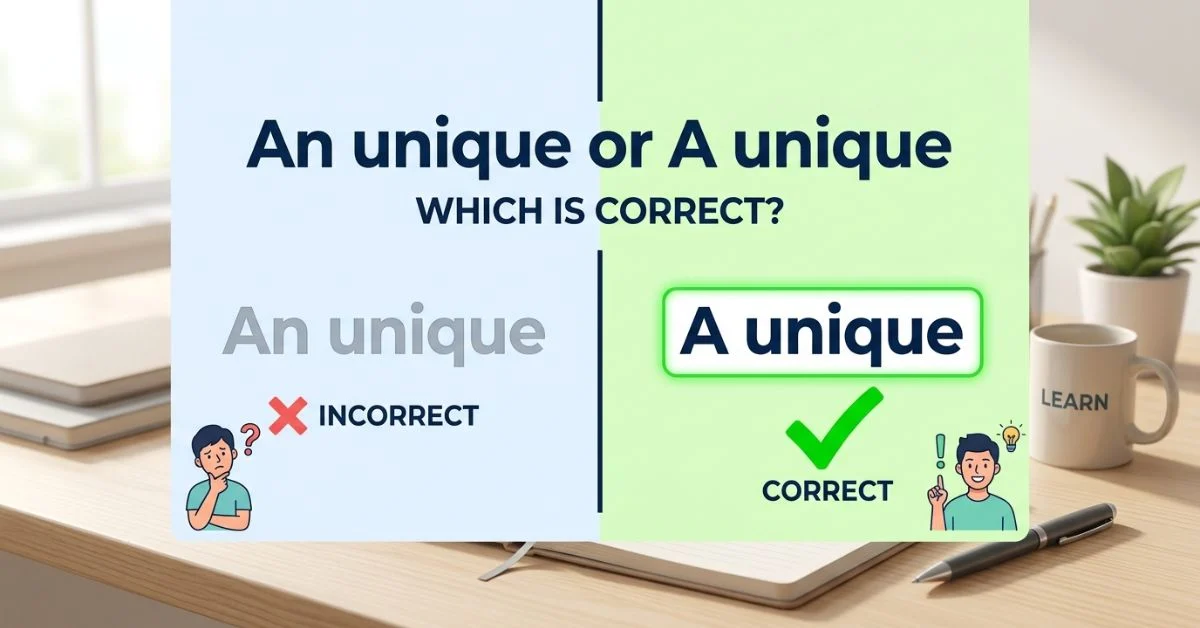
Many English learners get confused between “an unique or a unique”. At first, both look correct, but only one follows proper English grammar rules.
This confusion is very common in exams, writing, and daily communication because people focus on spelling instead of pronunciation.
The keyword An Unique or A Unique is widely searched by students, bloggers, and professionals who want to avoid grammar mistakes.
The main issue comes from the English article rule “a” vs “an,” which depends on sound, not spelling.
In this guide, you will learn the correct usage, meaning, origin, and real examples.
You will also understand why “an unique” is wrong and why “a unique” is always correct in standard English.
By the end, you will clearly understand An Unique or A Unique and never make this mistake again in writing or speaking.
Quick Answer
The correct phrase is “a unique” ✅
The incorrect phrase is “an unique” ❌
Examples:
- She has a unique talent.
- This is a unique opportunity.
- He is a unique person in the team.
👉 We use “a” because “unique” starts with a consonant sound (“yoo”), not a vowel sound.
The Origin of An Unique or A Unique
The word unique comes from the Latin word unicus, meaning “one of a kind.” It entered English with the same meaning.
The confusion in An Unique or A Unique comes from the English article system in English grammar, where “a” and “an” depend on pronunciation, not spelling.
Since “unique” starts with a “yoo” sound, it behaves like a consonant sound, so we use “a unique”.
British English vs American English Spelling
There is no difference between British English and American English for this rule.
Both follow the same grammar principle:
- ✔ a unique (correct in both UK & US English)
- ❌ an unique (incorrect everywhere)
Comparison Table
| Version | Usage | Correct/Incorrect | Reason |
|---|---|---|---|
| British English | a unique | Correct | consonant sound rule |
| American English | a unique | Correct | same grammar rule |
| Global English | an unique | Incorrect | wrong article usage |
Which Spelling Should You Use?
- 🇬🇧 UK / Commonwealth → use a unique
- 🇺🇸 USA → use a unique
- 🌍 Global writing / SEO → always use a unique
👉 No standard English variety accepts “an unique.”
Common Mistakes with An Unique or A Unique
❌ Wrong:
- She is an unique person.
- This is an unique idea.
- He has an unique style.
✅ Correct:
- She is a unique person.
- This is a unique idea.
- He has a unique style.
Why this mistake happens:
- People follow spelling instead of sound
- Confusion about vowel “u”
- Lack of grammar rule awareness
An Unique or A Unique in Everyday Examples
📧 Emails:
- We offer a unique solution for your business needs.
📰 News:
- The artist has a unique creative approach.
📱 Social Media:
- This café has a unique vibe!
📄 Formal Writing:
- The project required a unique problem-solving method.
An Unique or A Unique – Google Trends & Usage Data
Search data shows:
- “an unique” is commonly searched but incorrect
- “a unique” dominates correct usage globally
- High confusion among learners and non-native speakers
👉 The trend clearly shows a grammar mistake pattern, not correct variation.
Comparison Table – Keyword Variations
| Variation | Meaning | Correct/Incorrect | Notes |
|---|---|---|---|
| a unique | one of a kind | Correct | standard grammar |
| an unique | one of a kind | Incorrect | wrong article rule |
FAQs
1. Is “an unique” correct English?
No, it is grammatically incorrect.
2. Why is it “a unique” not “an unique”?
Because “unique” starts with a consonant sound (“yoo”).
3. Does “unique” always take “a”?
Yes, always “a unique.”
4. Is this rule same in British and American English?
Yes, both follow the same rule.
5. Why do people write “an unique”?
Because they follow spelling, not pronunciation.
6. Can I use “an unique” in informal writing?
No, it is still incorrect.
7. What is the correct sentence?
“She is a unique person.”
Conclusion
The confusion between An Unique or A Unique is very common, but the rule is simple in English grammar.
The correct form is always “a unique” because the word “unique” begins with a consonant sound, not a vowel sound. English articles depend on pronunciation, not spelling.
Both British and American English follow the same rule, so there is no variation across regions.
This makes it easy to remember and apply in all types of writing.
Using “an unique” is always incorrect and can make your writing look unprofessional.
Instead, practice using “a unique” in sentences until it becomes natural.
Once you understand this rule, you will avoid one of the most common grammar mistakes in English and improve your writing clarity and confidence.

I am Sophie Lane, a passionate voice behind Grammexa.com, where words meet clarity.
I am here to simplify language, comparisons, and meanings for curious minds worldwide.
I am driven by creativity, accuracy, and the love for powerful, understandable content.