Many English learners get confused between “everyone” and “every one” because they look almost the same but are used in different ways.
This small spelling difference often changes the meaning of a sentence completely.
That is why people frequently search for “everyone or every one meaning”, “hello everyone or every one”, and “everyone vs every one examples”.
The confusion happens because both expressions talk about people or things in groups, but grammar rules treat them differently.
One is an indefinite pronoun, and the other is a phrase that refers to individual items in a group.
Without understanding this difference, writers often make mistakes in emails, social media posts, exams, and professional communication.
In this article, you will clearly learn the meaning, usage rules, examples, common mistakes, and differences between these two terms.
You will also see real-life examples, a comparison table, FAQs, and usage tips.
By the end, you will confidently know when to write “everyone” and when to use “every one” correctly.
Quick Answer
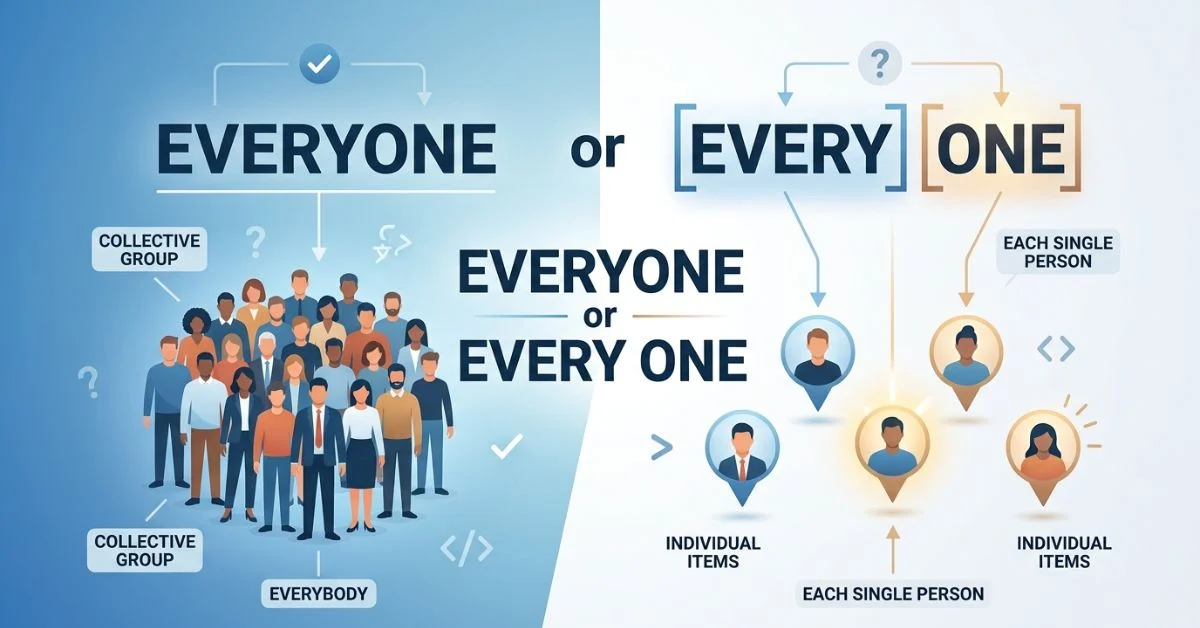
Everyone = refers to all people in a group (indefinite pronoun).
Every one = refers to each individual item or person separately in a group.
Examples:
- Everyone is invited to the party. ✔ (all people)
- Every one of the students passed the test. ✔ (each student individually)
The Origin of Everyone or Every One
The confusion comes from English evolution.
- Everyone developed as a single word indefinite pronoun.
- Every one comes from the phrase “every + one,” meaning each single unit.
Over time, “everyone” became fixed as a pronoun in modern English usage rules under English Grammar.
British English vs American English Spelling
Good news: There is no major UK vs US spelling difference here.
Both English types use the same rule.
| Form | Meaning | Usage |
|---|---|---|
| Everyone | All people | Common in both UK & US |
| Every one | Each individual | Common in both UK & US |
👉 Difference is not regional, but grammatical.
Which Spelling Should You Use?
- Use everyone when talking about people in general.
- Use every one when you can replace it with “each one.”
Simple test:
If “each” fits → use every one
If “all” fits → use everyone
Common Mistakes with Everyone or Every One
Hello every one (wrong in greetings)
Hello everyone (correct)
Everyone of us is ready
Every one of us is ready
Every one is happy (when meaning “all people”)
Everyone is happy
Everyone or Every One in Everyday Examples
Emails:
- Hello everyone, please find the report attached.
Social Media:
- Everyone loved the new update!
Formal Writing:
- Every one of the applicants was interviewed carefully.
News Style:
- Everyone was affected by the announcement.
Everyone or Every One – Usage Overview Table
| Phrase | Type | Meaning | Example |
|---|---|---|---|
| Everyone | Pronoun | All people | Everyone is here |
| Every one | Phrase | Each individual | Every one of them is here |
Everyone or Every One – Google Trends & Usage Data
Search trends show:
- “everyone” is far more commonly used
- “every one” appears mostly in grammar correction searches
- High interest in countries like:
- USA
- UK
- India
- Pakistan
This shows users mostly need clarity, not just definition.
FAQs
1. What is the difference between everyone and every one?
Everyone means all people, while every one means each individual item or person.
2. Is “hello every one” correct?
No, correct form is “hello everyone.”
3. Can “every one” be replaced with everyone?
Not always. “Every one” focuses on individuals, “everyone” is general.
4. Is everyone singular or plural?
Everyone is singular in grammar but refers to a group.
5. What is a synonym for everyone?
All, everybody, all people.
6. Which is more common?
Everyone is far more commonly used in modern English.
7. Can we use “every one of us”?
Yes, it is correct when emphasizing each person individually.
Conclusion
Understanding the difference between everyone and every one is important for clear and correct English writing.
Although they look similar, their meanings are not the same. “Everyone” is an indefinite pronoun that refers to all people in a group together.
It is widely used in daily communication, emails, social media, and formal writing.
On the other hand, “every one” is used when we want to focus on each individual separately within a group.
Many learners confuse these terms because spoken English does not clearly show the difference, but written English follows strict grammar rules under English Grammar.
By remembering a simple rule, everyone = all people, every one = each one individually, you can avoid common mistakes easily.
Whether you are writing a greeting like “hello everyone” or a formal sentence like “every one of the students passed,” using the correct form improves your clarity and professionalism.
With practice and examples, this difference becomes very easy to understand and apply in everyday writing.

I am Clara Hayes a unique and modern name with a classy, trending appeal.
I am known for elegance, simplicity, and global style.
On Grammexa.com, I stand out as a perfect contemporary name choice.