You are writing an email, article, or school assignment. You want to mention the middle of the day.
Then you pause—should it be midday or mid-day? Both look correct. Both appear in books, websites, and even dictionaries.
This small difference often confuses writers, students, and content creators.
The confusion comes from English spelling rules. Some words are written as one word, while others use a hyphen.
Over time, many hyphenated words lose the hyphen and become a single word. “Midday” and “mid-day” are part of this change.
People search “midday or mid-day” to understand which spelling is correct in modern English, and whether the hyphen is still needed.
This guide will clear that confusion in the simplest way. You will learn the correct usage, history, grammar rules, and real-life examples so you can write confidently without mistakes.
Quick Answer
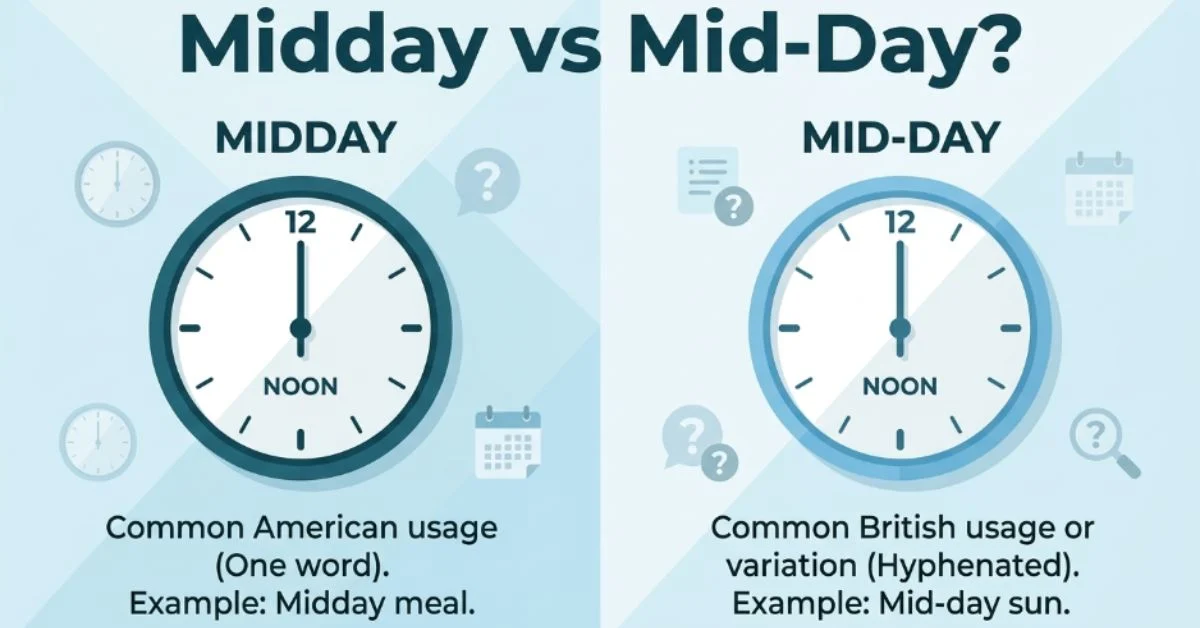
Both midday and mid-day are correct, but midday is the modern standard.
- Midday → Most commonly used today (preferred form)
- Mid-day → Older or more formal/variant spelling
Examples:
- We will meet at midday. ✅
- The meeting is scheduled for mid-day. (less common)
👉 Simple rule:
Use midday in most writing unless following a strict style guide that prefers hyphens.
The Origin of Midday or Mid-Day
The word comes from Old English:
- “mid” = middle
- “day” = day
Originally, it was written as two words: “mid day”, meaning the middle of the day when the sun is highest.
Over time:
- It became mid-day (hyphen added for clarity)
- Later evolved into midday (modern closed form)
This is a common pattern in English:
- Words often start separate → become hyphenated → become one word
So:
- Old form → mid day
- Transitional form → mid-day
- Modern form → midday
British English vs American English Spelling
In this case, both regions mostly agree, but usage trends differ slightly.
| Form | British English | American English | Usage Status |
|---|---|---|---|
| midday | Common | Very common | Standard modern form |
| mid-day | Occasionally used | Rare | Older/variant form |
| mid day | Very rare | Very rare | Obsolete |
Key Insight:
- Both UK and US prefer midday
- Hyphenated form is becoming outdated in both regions
Which Spelling Should You Use?
Your choice depends on audience and writing style.
🇺🇸 For American English:
- Use midday (standard)
🇬🇧 For British English:
- Use midday (preferred modern usage)
🌍 For global content (blogs, SEO, business writing):
- Use midday for clarity and consistency
👉 Safe rule:
Always choose midday unless a style guide requires hyphenation.
Common Mistakes with Midday or Mid-Day
Writing “mid day” as two separate words in formal writing
Correct: midday
Mixing forms in one article
Correct: stick to one spelling
Using hyphen unnecessarily
Correct: midday is enough in modern English
Assuming both forms mean different things
They mean the same thing
Midday or Mid-Day in Everyday Examples
📧 Email:
- The report will be ready by midday.
📰 News:
- Temperatures will peak around midday today.
📱 Social Media:
- Feeling tired at midday already 😅
📄 Formal Writing:
- The conference begins at midday sharp.
Midday or Mid-Day – Google Trends & Usage Data
Search behavior shows:
- “midday” is far more popular globally
- “mid-day” appears mostly in:
- older publications
- some editorial style guides
- Searches for “midday or mid-day” spike among:
- students
- writers
- SEO content creators
👉 Insight:
People search this keyword mainly to confirm correct modern spelling rules.
Comparison Table: Midday vs Mid-Day vs Mid Day
| Variation | Form Type | Usage Level | Status |
|---|---|---|---|
| midday | one word | high | standard |
| mid-day | hyphen | medium | outdated |
| mid day | two words | low | incorrect in formal writing |
FAQs
1. Is it midday or mid-day?
Both are correct, but midday is the modern preferred spelling.
2. What does midday mean?
It means the middle of the day, usually around 12 PM (noon).
3. Is mid-day outdated?
Yes, it is considered an older spelling.
4. Can I write mid day as two words?
No, it is not correct in formal writing.
5. Is midday the same as noon?
Yes, in most contexts they refer to the same time.
6. Which spelling is best for SEO?
Use midday for higher search consistency.
7. Do British and American English differ here?
Not much—both prefer midday today.
Conclusion
The confusion between midday or mid-day is a perfect example of how English evolves over time.
What once started as two separate words slowly changed into a hyphenated form and finally became a single modern word: midday.
Today, both forms still exist, but midday is clearly the standard in both American and British English.
The hyphenated version, mid-day, is now mostly outdated and appears only in older texts or specific style guides.
For writers, students, and content creators, the safest and most professional choice is simple: use midday.
It is clean, widely accepted, and preferred in modern communication.
Whether you are writing emails, blogs, or academic work, sticking to this form will keep your writing clear and correct.
Understanding small differences like this helps improve writing quality and avoids confusion.
Now you can confidently choose the right spelling every time.

I am Daniel Cross, a unique and modern name with a strong digital identity.
I am a trending presence on Grammexa.com, representing creativity and innovation.
I am here to share unique ideas and fresh online trends.