English words can be tricky. Some words look almost the same but mean very different things. Discrete vs discreet is one of the most searched word pairs online.
Many people type this keyword because they are unsure which spelling is correct. Both words sound the same. Both are spelled almost the same. But their meanings are not the same at all.
This confusion often appears in emails, school work, news writing, and even professional documents.
A small spelling mistake can change the whole meaning of a sentence. For example, asking someone to be discrete instead of discreet can sound strange or wrong.
That is why people search for discrete vs discreet before writing important content.
This article solves that problem fast and clearly. You will learn the simple meaning of each word.
You will see real examples. You will understand when to use which spelling. By the end, you will feel confident using both words correctly in daily and professional writing.
Discrete vs Discreet Quick Answer
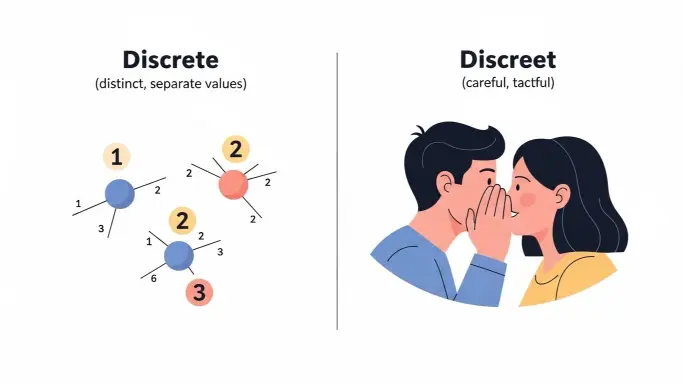
Discrete means separate, distinct, or individual.
Discreet means careful, private, or not attracting attention.
Examples:
- The report has three discrete sections.
- Please be discreet about this meeting.
Easy trick:
- Discrete = separate things
- Discreet = quiet behavior
The Origin of Discrete vs Discreet
Both words come from Latin, but their meanings changed over time.
- Discrete comes from the Latin word discretus, meaning “separated.”
- Discreet also comes from discretus, but it evolved to mean “wise” or “careful.”
In Middle English, writers started using different spellings to show different meanings. Over time, English kept both spellings. That is why one extra “e” changes the meaning today.
British English vs American English Spelling
There is no spelling difference between British and American English for these words. Both regions use the same forms.
| Word | Meaning | US English | UK English |
| Discrete | Separate or distinct | ✔ Same | ✔ Same |
| Discreet | Careful or private | ✔ Same | ✔ Same |
The confusion is about meaning, not region.
Which Spelling Should You Use?
Choose the spelling based on meaning, not location.
- Use “discrete” when talking about things that are separate.
- Use “discreet” when talking about behavior, privacy, or silence.
Audience tips:
- US audience: Same rule applies.
- UK/Commonwealth: Same rule applies.
- Global writing: Meaning matters more than accent or region.
Common Mistakes with Discrete vs Discreet
Here are common errors people make:
❌ Please be discrete about this secret.
✔ Please be discreet about this secret.
❌ The system has discreet parts.
✔ The system has discrete parts.
Tip:
If you can replace the word with “separate,” use discrete.
If you can replace it with “private,” use discreet.
Discrete vs Discreet in Everyday Examples
Emails
- “Each task is discrete and independent.”
- “Please be discreet when sharing this information.”
News
- “The study analyzed discrete data points.”
- “The official gave a discreet response.”
Social Media
- “Life has discrete moments of joy.”
- “Try to be discreet online.”
Formal Writing
- “The model uses discrete variables.”
- “The lawyer handled the case discreetly.”
Discrete vs Discreet Google Trends & Usage Data
Search data shows that “discrete vs discreet” spikes during exam seasons and job application periods. Students, writers, and professionals search it most.
- High searches: US, UK, India, Pakistan, Canada
- Top contexts: Education, business writing, legal content
- Reason: Sound-alike words with different meanings
This shows strong and ongoing user interest.
Discrete vs Discreet Comparison Table
| Feature | Discrete | Discreet |
| Meaning | Separate | Careful |
| Use | Objects, data | Behavior, speech |
| Example | Discrete units | Discreet tone |
| Memory Tip | Separate | Private |
FAQs Discrete vs Discreet
1. Are discrete and discreet interchangeable?
No. They have different meanings.
2. Which word means private?
Discreet.
3. Which word means separate?
Discrete.
4. Is one spelling British and the other American?
No. Both spellings are used everywhere.
5. How can I remember the difference?
Extra “e” in discreet = extra care.
6. Can discreet be used for data?
No. Data is discrete, not discreet.
7. Is this a common grammar mistake?
Yes. It is very common.
Conclusion
Understanding discrete vs discreet is easier than it looks. The key is meaning, not spelling style or location.
Discrete talks about things that are separate or distinct. Discreet talks about behavior that is careful, quiet, or private. One small letter changes everything.
This confusion happens because both words sound the same. Many writers rely on sound instead of meaning.
That leads to mistakes in emails, articles, and even legal or academic writing. Using the wrong word can confuse readers or weaken your message.
Always stop and ask one question: Am I talking about separation or privacy? That single step will help you choose the right word every time.
With practice, the difference becomes natural.
Mastering small word pairs like this makes your writing clearer, stronger, and more professional.

I am Maya Brooks, a passionate writer and language enthusiast at Grammexa.com, where words are explained with clarity and purpose.
I am dedicated to simplifying confusing terms, comparisons, and grammar topics for readers worldwide.
I am here to help you learn smarter, write better, and understand language with confidence.