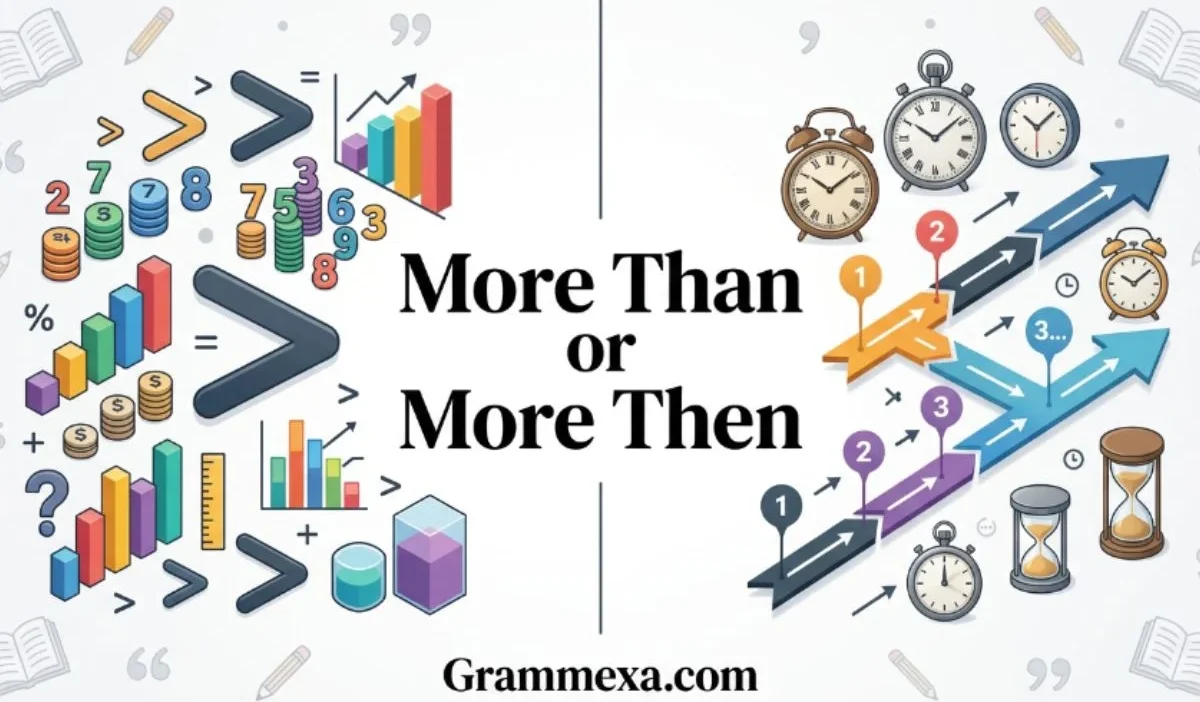
Have you ever typed more then and wondered whether it was correct? You are not alone.
Many English learners and writers confuse more than or more then because these words look and sound almost identical. However, they have completely different meanings and uses.
This small mistake can change the meaning of a sentence and make professional writing, emails, essays, or articles look less polished.
Students, bloggers, job seekers, and professionals often search for this keyword because they want a simple rule to remember. They need a quick explanation that helps them choose the correct word every time.
This guide explains the difference between more than and more then, including meanings, examples, common mistakes, usage rules, and updated language trends.
Let’s clear up this confusion once and for all.
More Than or More Then Quick Answer
The simple rule is:
More than = Used for comparison, amount, or quantity
More then = Usually incorrect when talking about comparison
Examples:
- I have more than five books.
- She earns more than her brother.
- The product costs more than $50.
Now look at then:
- We finished dinner, then we watched a movie.
- Complete the task, then send the report.
Remember:
👉 Than = Comparison
👉 Then = Time or Sequence
If you are comparing something, always use more than.
The Origin of More Than or More Then
The confusion between more than and more then comes from the history of the English language.
The word than comes from Old English and was originally used for comparisons. Over time, it became the standard word for showing differences in amount, size, number, or degree.
The word then also developed from Old English. However, its meaning changed toward time, order, and sequence.
Because both words came from similar language roots, they still look and sound alike today. However, their meanings are now completely different.
That is why writers often mix them up despite the simple difference.
British English vs American English Spelling
There is no spelling difference between British English and American English for more than and then.
Both varieties use:
- More than → Correct for comparison
- Then → Correct for time or sequence
| Usage | Correct Form | Example | US English | UK English |
|---|---|---|---|---|
| Comparison | More than | She has more than 10 books. | Same | Same |
| Time/Order | Then | We arrived, then we left. | Same | Same |
| Incorrect Comparison | More then | She has more then 10 books. | Wrong | Wrong |
The rule remains the same worldwide.
Which Spelling Should You Use?
The correct choice depends on meaning, not location.
Use More Than When:
- Comparing two things
- Talking about numbers
- Describing amounts
- Showing a higher degree
Examples:
- This laptop costs more than $500.
- He has more than 20 years of experience.
Use Then When:
- Talking about time
- Showing the next action
- Explaining a sequence
Examples:
- First read the instructions, then start the project.
- She finished her work, then went home.
Simple rule:
Comparison → Than
Time or Sequence → Then
Common Mistakes with More Than or More Then
Mistake 1: Using More Then for Amounts
❌ I have more then 50 emails.
✅ I have more than 50 emails.
The sentence compares quantity, so than is correct.
Mistake 2: Using More Then for Feelings
❌ She is more then happy.
✅ She is more than happy.
Here, more than means “very” or “extremely.”
Mistake 3: Confusing Then with Comparison
❌ He earns more then his colleague.
✅ He earns more than his colleague.
The sentence compares earnings, so use than.
Mistake 4: Using Than for Sequence
❌ More than we went home.
✅ Then we went home.
The sentence describes what happened next, so use then.
More Than or More Then in Everyday Examples
Email Example:
“I received more than 100 applications for the position.”
News Example:
“The company reported more than $2 million in revenue.”
Social Media Example:
“I love this movie more than any other.”
Formal Writing Example:
“The results were more than satisfactory.”
Casual Conversation Example:
“Finish your homework, then watch TV.”
These examples show how often this grammar rule appears in daily communication.
More Than or More Then – Google Trends & Usage Data
Recent search patterns show that more than or more then remains a popular grammar query because many people confuse these two similar-looking words.
People commonly search:
- “Is it more than or more then?”
- “More then meaning”
- “Difference between than and then”
The incorrect form more then appears frequently in informal online writing, comments, and messages. However, professional writing, education, and publishing consistently use more than for comparisons.
Search interest commonly comes from:
- United States
- United Kingdom
- Canada
- Australia
- India
The main reason behind this confusion is pronunciation. Both words sound similar, but their functions are different.
Comparison Table: Than vs Then
| Word | Meaning | Used For | Example |
|---|---|---|---|
| Than | Comparison | More, less, bigger, smaller | She is taller than me. |
| Then | Time or sequence | Next action or order | We ate, then we slept. |
FAQs
1. Is “more then” ever correct?
No. When comparing amounts, numbers, or things, more than is the correct form.
2. Why do people confuse than and then?
People confuse them because they look similar, sound similar, and come from related historical roots.
3. Is more then a spelling mistake?
It is usually a word choice mistake because the writer selects the wrong word.
4. Do British and American English use different forms?
No. Both British and American English use more than and then in the same way.
5. Can I say “more then that”?
No. The correct phrase is more than that.
6. How can I remember the difference?
Remember:
Than = Compare
Then = Time
7. Is this mistake common?
Yes. It is one of the most common mistakes involving similar-sounding English words.
8. Can “then” mean something other than time?
Yes. It can also refer to a situation or condition, such as “If that is true, then we agree.”
9. Is “more than” only used with numbers?
No. It can also describe feelings, qualities, and degrees.
Example: She is more than ready.
10. Is “more then” acceptable in casual writing?
It may appear in informal messages, but it is still considered incorrect in standard English.
11. Which word should I use in comparisons?
Always use than.
Example: This book is better than that one.
12. Which word shows what happens next?
Use then.
Example: Finish the work, then leave.
13. Can “than” start a sentence?
Yes, especially in comparisons.
Example: More than expected, the results improved.
14. Why is “more than” common in professional writing?
Because it clearly shows comparison and follows standard grammar rules.
15. How do I avoid this mistake?
Check the meaning first. If you are comparing something, choose than. If you are showing time or order, choose then.
Conclusion
The difference between more than and more then is simple but important. More than is used for comparisons, amounts, and degrees, while then is used for time, order, and sequence.
This confusion happens because both words look and sound similar. However, their meanings are completely different.
The easiest way to remember the rule is:
Than compares. Then tells time.
Both American and British English follow the same usage rules, making this easier for global writers.
By understanding this small difference, you can improve your grammar, write more clearly, and avoid common mistakes in professional communication.
Use more than for comparison and then for sequence, and your writing will always be accurate.

I am Daniel Cross, a unique and modern name with a strong digital identity.
I am a trending presence on Grammexa.com, representing creativity and innovation.
I am here to share unique ideas and fresh online trends.