English has many confusing word pairs that look and sound almost identical but have completely different meanings. Discrete vs discreet is one of the most common examples.
Many people search for this word pair because they are unsure which spelling is correct. Both words sound the same, and their spellings are very similar. However, using the wrong word can completely change the meaning of a sentence.
This confusion appears often in emails, academic writing, business documents, and professional communication. A small spelling difference can create a big meaning difference.
For example, asking someone to be discrete about private information is incorrect because the intended meaning is usually discreet.
This guide explains the difference between discrete vs discreet in simple language. You will learn their meanings, history, correct usage, common mistakes, examples, and easy memory tips.
By the end, you will know exactly when to use each word and avoid this common English mistake.
Discrete vs Discreet Quick Answer
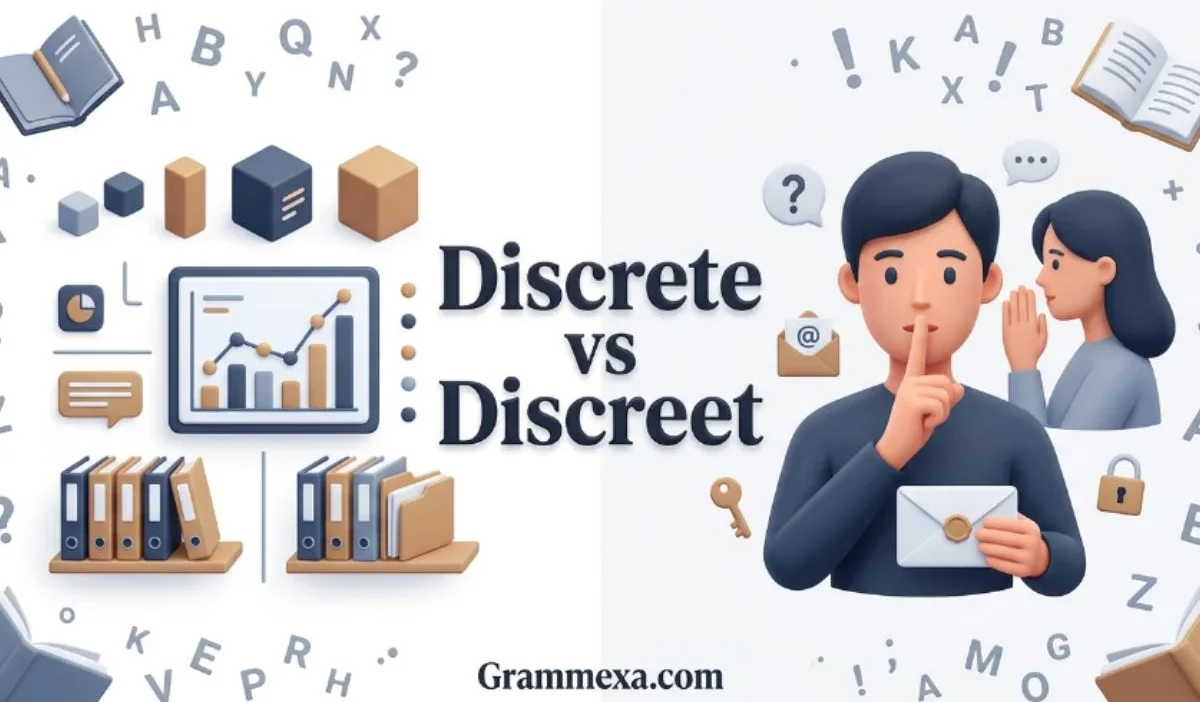
Discrete means separate, distinct, or individually different.
Discreet means careful, private, or showing good judgment to avoid attention.
Examples:
- The machine has several discrete parts.
- Please be discreet about this confidential information.
Easy Memory Trick:
Discrete = Separate
Discreet = Private
If you are talking about things that are divided or independent, use discrete.
If you are talking about someone’s behavior, privacy, or secrecy, use discreet.
The Origin of Discrete vs Discreet
Both discrete and discreet come from the Latin word discretus, which means “separated” or “distinguished.”
Over time, English developed two different spellings with different meanings.
Discrete
The word discrete kept its original meaning of being separate or distinct.
Examples:
- Discrete data points
- Discrete categories
- Discrete units
Discreet
The word discreet developed a different meaning related to wisdom, caution, and careful behavior.
Examples:
- A discreet person
- A discreet conversation
- A discreet decision
Although both words share the same origin, their modern meanings are completely different.
British English vs American English Spelling
There is no spelling difference between British English and American English for discrete and discreet.
Both regions use the same spelling and meaning.
| Word | Meaning | US English | UK English |
|---|---|---|---|
| Discrete | Separate or distinct | Same | Same |
| Discreet | Careful or private | Same | Same |
The confusion is not related to British or American English. The issue is understanding the meaning of each word.
Which Spelling Should You Use?
Choose between discrete vs discreet based on meaning, not location.
Use Discrete When You Mean:
- Separate
- Individual
- Distinct
- Independent
Examples:
- The project has three discrete stages.
- The scientist studied discrete variables.
Use Discreet When You Mean:
- Private
- Careful
- Secretive
- Respectful of privacy
Examples:
- She was discreet about the personal matter.
- The company handled the situation in a discreet way.
Simple Question:
Ask yourself:
Does it mean separate?
→ Use discrete
Does it mean private or careful?
→ Use discreet
Common Mistakes with Discrete vs Discreet
Mistake 1: Using Discrete for Privacy
❌ Please be discrete about this information.
✅ Please be discreet about this information.
The sentence refers to privacy, so discreet is correct.
Mistake 2: Using Discreet for Separate Things
❌ The system contains discreet parts.
✅ The system contains discrete parts.
The parts are separate, so discrete is correct.
Mistake 3: Confusing Similar Sounds
Both words sound almost identical, which causes many writing mistakes.
A good way to avoid confusion is to focus on the meaning instead of pronunciation.
Discrete vs Discreet in Everyday Examples
Email Examples
- Each department operates as a discrete unit.
- Please be discreet when discussing this project.
News Examples
- The research identified several discrete groups.
- The official gave a discreet response.
Social Media Examples
- The app collects discrete pieces of information.
- Try to be discreet when sharing personal details online.
Formal Writing Examples
- The study uses discrete mathematical models.
- The manager handled the issue in a discreet manner.
Discrete vs Discreet Google Trends & Usage Data
Search interest for discrete vs discreet remains strong because these words frequently appear in education, professional writing, and language learning.
Recent search patterns show interest mainly from:
- United States
- United Kingdom
- India
- Canada
- Australia
The keyword is commonly searched in contexts such as:
- English learning
- Academic writing
- Business communication
- Grammar correction
The main reason people search this term is simple: both words sound the same but have different meanings.
Discrete vs Discreet Comparison Table
| Feature | Discrete | Discreet |
|---|---|---|
| Meaning | Separate or distinct | Careful or private |
| Used For | Objects, data, categories | Behavior, actions, communication |
| Part of Speech | Adjective | Adjective |
| Example | Discrete sections | Discreet conversation |
| Memory Tip | Separate | Private |
FAQs
1. Are discrete and discreet the same?
No. They sound similar but have different meanings.
2. Which word means private?
Discreet means private, careful, or avoiding attention.
3. Which word means separate?
Discrete means separate, distinct, or individual.
4. Are discrete and discreet spelled differently in British English?
No. Both British and American English use the same spellings.
5. How can I remember the difference?
Remember:
Discrete = Separate
Discreet = Private
6. Can I use discreet for data?
No. Data is usually described as discrete because it refers to separate values or units.
7. Is discrete vs discreet a common English mistake?
Yes. Many writers confuse these words because they have the same pronunciation.
Conclusion
Understanding discrete vs discreet becomes easy when you focus on meaning instead of spelling.
Discrete describes things that are separate, distinct, or divided into individual parts. Discreet describes people, actions, or communication that are careful, private, or respectful of secrecy.
This confusion happens because both words sound identical, but one letter changes their meaning completely.
Whenever you are unsure, ask yourself one simple question: Am I talking about separation or privacy?
If the answer is separation, use discrete. If the answer is privacy or careful behavior, use discreet.
Learning small differences like this helps make your writing clearer, more accurate, and more professional.

I am Maya Brooks, a passionate writer and language enthusiast at Grammexa.com, where words are explained with clarity and purpose.
I am dedicated to simplifying confusing terms, comparisons, and grammar topics for readers worldwide.
I am here to help you learn smarter, write better, and understand language with confidence.